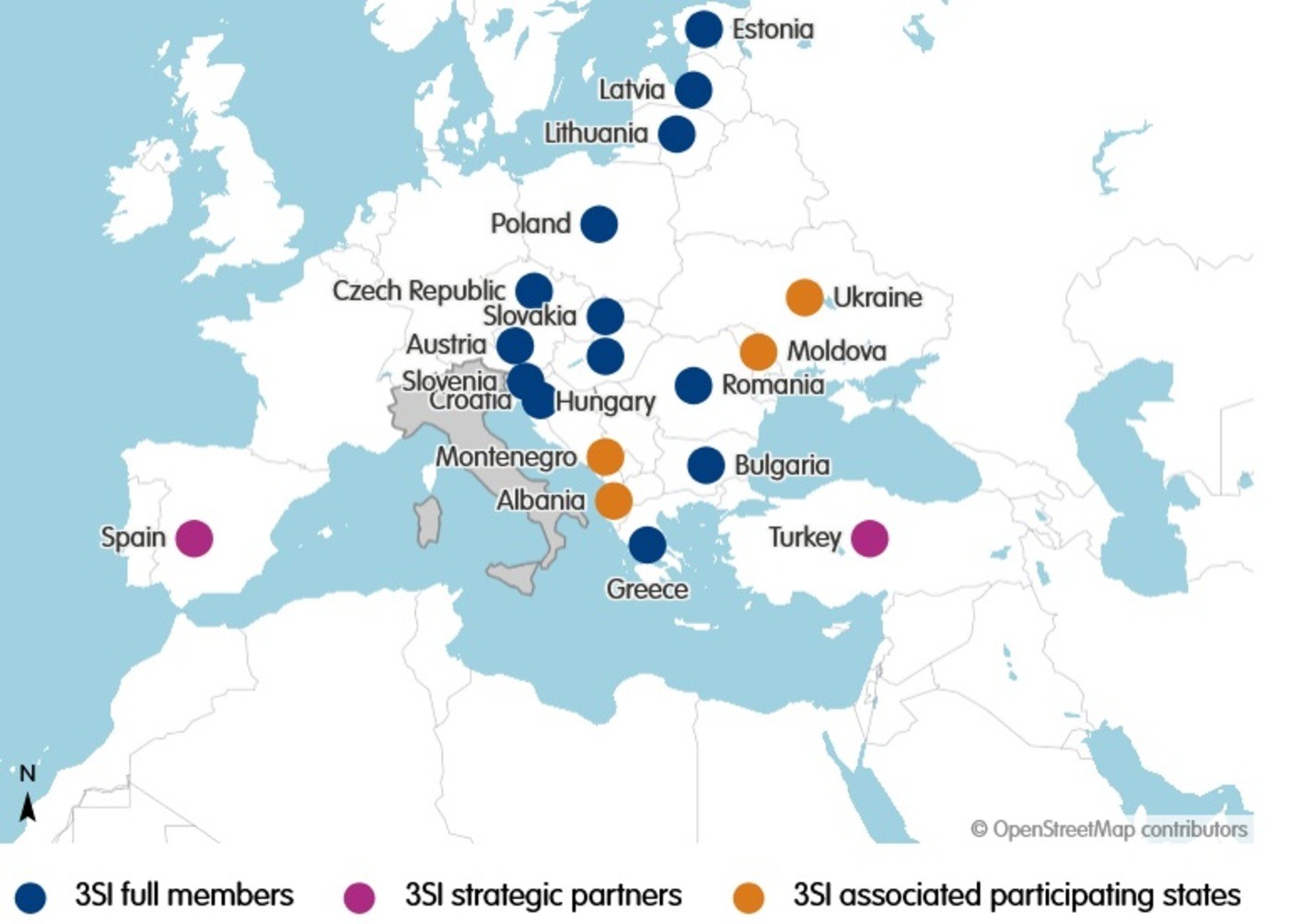
Administrative Division of the Three Seas Initiative Countries
Bundeslands, districts, komitats… What are the administrative division systems used in the 3SI countries? In order to use the same regional units for statistical purposes, in 2003 the EU introduced NUTS – the Nomenclature of Territorial Units for Statistics. The NUTS classification is divided into three levels: NUTS 1, NUTS 2 and NUTS 3. The latter two are used for evaluating whether countries meet eligibility criteria for support within the framework of UE structural policy. At the NUTS 2 level, aid is provided to problem areas with low development and at the NUTS 3 level to areas that need restructuring and to border regions. At the same time, official administrative units of each country have different names and sizes and their governing bodies have different competences.
Austria is divided into 9 states [Bundesländer]: Burgenland, Carinthia, Lower Austria, Upper Austria, Salzburg, Styria, Tyrol, Vorarlberg, and Vienna – this division corresponds to NUTS 2. The federal states are further divided into statutory cities and regions. The exception is the Vienna, which is divided into districts.
The basic administrative division of Bulgaria corresponds to the NUTS 3 level – 28 provinces [oblasti] bearing the same names as their capital cities. Twenty-six of them are: Blagoevgrad, Burgas, Haskovo, Dobrich, Gabrovo, Yambol, Kyustendil, Kardzhali, Lowech, Montana, Pazardzhik, Pernik, Pleven, Plovdiv, Razgrad, Ruse, Silistra, Sliven, Smolyan, Stara Zagora, Shumen, Targovishte, Varna, Veliko Tarnovo, Vidin, Vratsa. The last two are Sofia City and the Sofia district, as the capital of Bulgaria constitutes a separate administrative entity.
Another country of the Three Seas Initiative is Croatia. Until 2014 that country had remained outside the NUTS classification. At present, Croatia is divided into 20 counties [županija] and one city- county – Zagreb; this division corresponds to NUTS 3 level. The names of particular counties are as follows: Bjelovar-Bilogora, Brod-Posavina, Zadar, Krapina-Zagorje, Sisak-Moslavina, Karlovac, Varaždin, Koprivnica-Križevci, Primorje-Gorski Kotar, Lika-Senj, Virovitica-Podravina, Požega-Slavonia, Osijek-Baranja, Šibenik-Knin, Vukovar-Syrmia, Split-Dalmatia, Istria, Dubrovnik-Neretva, Međimurje, Zagreb.
The administrative division of the Czech Republic corresponds to the NUTS 3 level. The country is divided into the so-called ‘kraje’, i.e. self-governing regions, thirteen in total. The fourteenth separate administrative unit is the City of Prague. The Czech regions are as follows: Central Bohemian, South Bohemian, Plzeň, Karlovy Vary, Ústí nad Labem, Liberec, Hradec Králové, Pardubice, Vysočina, South Moravian, Olomouc, Zlin, Moravian-Silesian.
Estonia is altogether a different case. Its local administrative units are 15 provinces, yet in the NUTS 3 classification Estonia has only got five regions. This is because only two provinces correspond in size to NUTS 3 level units. These are Põhja-Eesti and Kirde-Eesti. The remaining regions have been combined into groups. The Kesk-Eesti region is made up of three provinces, the Western region comprises four provinces, while the Southern region – six provinces.
Our eastern neighbour, Lithuania, has 10 units corresponding to NUTS 3 level. Those are the following districts: Klaipeda, Kaunas, Marijampole, Alytus, Panevėžys, Šiauliai, Tauragė, Telšiai, Utena, Vilnius.
Latvia, on the other hand, constitutes a single NUTS 2 unit with five NUTS 3-level statistical regions: Kurzeme, Latgale, Riga, Vidzeme and Zemgale. The NUTS 3 region of Riga is divided into two planning regions, Riga City and Riga Region – Pieriga; hence, in fact, Latvia has six regions at the NUTS 3 level.
The NUTS classification for Poland is the most obvious, as 17 voivodships are NUTS 2 level units: Dolnośląskie, Kujawsko-Pomorskie, Lubelskie, Lubuskie, Łódzkie, Małopolskie, Mazowieckie, Opolskie, Podkarpackie, Podlaskie, Pomorskie, Śląskie, Świętokrzyskie, Warmińsko-Mazurskie, Wielkopolskie and Zachodniopomorskie. The Warsaw capital district separated from the Mazowieckie voivodship forms the 17th administrative unit.
The administrative division of Romania is perceived as simpler than in other 3SI countries. There are eight regions at the NUTS 2 level. This simplicity is also reflected by their names: București – Ilfov, Centru, Sud, Sud-Est, Sud-Vest, Nord-Est, Nord-Vest and Vest.
Another country that has ‘kraje’ as administrative units is Slovakia. Those are NUTS 3 level units and there are eight of them: Bratislava, Trnava, Trenčín, Nitra, Žilina, Banská Bystrica, Prešov and Košice.
The situation in Slovenia is similar to that in Estonia: local administrative units are communes. However, 212 communes of Slovenia have been grouped into 12 regions corresponding to NUTS 3 classification units. The regions of Eastern Slovenia are: Mura, Drava, Carinthia, Savinja, Central Sava, Lower Sava, Southeast Slovenia, and Littoral; those in Western Slovenia are: Central Slovenia, Upper Carniola, Gorizia, and Coastal–Karst Region.
The komitats mentioned in the beginning of this text are administrative units of Hungary. They are NUTS third-level units and there are twenty of them. Their names are: Budapest, Bács-Kiskun, Baranya, Békés, Borsod-Abaúj-Zemplén, Csongrád, Fejér, Győr-Moson-Sopron, Hajdú-Bihar, Heves, Jász-Nagykun-Szolnok, Komárom-Esztergom, Nógrád, Pest, Somogy, Szabolcs-Szatmár-Bereg, Tolna, Vas, Veszprém, Zala.
As can be seen on the example of the Three Seas Initiative countries, the NUTS statistical division not always matches the administrative division of a given country, just like in the case of Estonia, Latvia, or Slovenia. The main intention behind the introduction of the NUTS classification is solving the problem of differences in administrative divisions and inevitable changes of those divisions in order to avoid inaccuracies in comparing statistical data.
Read more